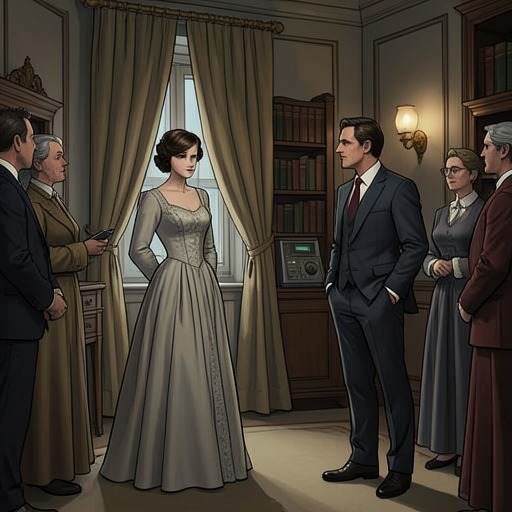
Claire Farel
Les Choses humainesClaire Farel is an essayist whose life is shaped by departures: from the United States after her father’s death, from a marriage that had become emotionally distant, and finally from the composure she tries to maintain through her son Alexandre Farel’s trial. Her story brings together intellectual achievement, illness, intimate reinvention, and the painful distinction between loving a child and being able to shield him from consequence.
Identity and Background
Claire, born Claire Davis, is the daughter of Dan Davis, a Harvard law professor, and Marie Coulier, a French translator of English. Her parents’ family story begins with their meeting outside the Sorbonne and their subsequent marriage in the Washington suburbs. Marie gave up ambitions of emancipation to care for her daughter, an experience she regarded as alienating rather than as the fulfillment of an innate maternal calling. The account presents Claire’s childhood against this complicated inheritance: a mother who later devoted herself intensely to her, but who had not experienced motherhood as a natural vocation.
Claire lived with her father in Cambridge until he died of a rapidly progressing cancer when she was thirteen. She then returned to France to live with her mother in a small mountain village near Grenoble. Marie, who worked part-time for French publishing houses, tried to make up for the years of separation by taking charge of Claire’s education. She taught her several languages, literature, and philosophy. That education forms part of the background to Claire’s later career, though the narrative leaves open how much of her achievement can be attributed to her mother’s instruction.
After studying at Normale Sup, Claire joined a university philosophy department. She became a recognized essayist and published six books. Her third, The Power of Women, written when she was thirty-four, established her critical reputation. The intellectual life that began in her mother’s lessons thus develops into a public identity of her own.
Marriage, Illness, and Departure
Claire and Jean Farel shared a life of conversation as well as family duty. They spoke for hours about philosophy and politics, sometimes with guests at their frequent dinners in their large apartment on avenue Georges-Mandel. Their son Alexandre was the bond that held them most firmly together. By the time he was twenty-one, he had studied at École polytechnique and gone to Stanford University in California for the September term. During his absence, in early October 2015, Claire abruptly told Jean that she had met someone else and left him.
Her departure follows a period in which she had already confronted her own mortality. Five years earlier, she had been diagnosed with breast cancer. After learning that she had recovered, she decided to live with an intensity made possible by an acute awareness that life was finite. The narrative describes this as a transformation through ordeal, while making clear that her turn toward a more vivid life did not mean she was ready to surrender or withdraw from it.
Claire made the separation abrupt and final in its immediate form: she packed her bags and left a postcard showing a mountain landscape on the living-room table. On its reverse she wrote, “C’est fini.” The short message gives the departure the force of a cut rather than a negotiated ending. It also contrasts with the long philosophical conversations that had marked her marriage: the relationship’s conclusion is reduced to a few words, while the consequences continue through their shared son.
Relationship with Adam Wizman
Claire’s new relationship with Adam Wizman becomes a consuming, mutually chosen intimacy. At the height of their passion, Claire imagined a form of fusion and a life organized around their sexual relationship. Adam had lost his job and was present with her; both were deeply in love and increasingly available to one another. Their closeness brought a corresponding retreat from the rest of their lives: they refused invitations, distanced themselves from their respective friends, and disregarded the friends’ objections. The relationship is presented not simply as a romance but as a reorganization of daily life that narrows the couple’s social world.
That private reorganization occurs within the disruption of two families. Adam’s family had been affected by antisemitic violence in France, after which he and his wife removed their daughters from school and decided, as many of their traumatized acquaintances did, to leave the country. The family’s conversations repeatedly returned to the danger facing European Jews and the possibility that they or their children might eventually have to leave. Adam and his family rented an apartment in Ra’anana, northeast of Tel Aviv, for six months. The experience failed: although Adam felt a deep attachment to Israel, he did not believe he could integrate there without changing himself. He found the daily atmosphere aggressive, felt uncomfortable with the constant familiarity of life among other Jews, and did not experience the solidarity he sometimes felt when encountering another Jew abroad.
Adam was also troubled by what he saw as the absence of political consciousness among people who had emigrated for similar reasons. He felt that the Israeli-Palestinian conflict had become an abstract reality that people denied, accepting a moral retreat in the name of personal safety and quiet. The family returned to France, discouraged by the failure of their attempt to relocate. Adam then taught French at a Jewish school, and the family lived within a largely communal social world. These details place his relationship with Claire alongside unresolved questions of safety, belonging, political responsibility, and family separation rather than treating it as an isolated affair.
Motherhood and the Trial
Claire’s relationship with Alexandre remains central even after her marriage to Jean has ended. At the trial’s verdict, she gives her son a brief wave, then hurries to the glass enclosure to speak with him. He is to return to Fresnes Prison for the administrative process of release, and she expects to meet him there. The gesture is small, but it shows where her attention is fixed: despite the separation from Jean and the public scrutiny around the case, her immediate concern is her son’s return from custody.
During the proceedings, the presiding judge directly acknowledges the burden placed on Mila Wizman by having to recount her experience repeatedly. She recalls that Mila had been unable to speak about it at earlier meetings and had wept, and she recognizes the pressure involved in appearing before the court. The judge’s remarks establish the emotional cost of the process without making Claire the center of that testimony. Claire’s role is that of a mother watching a case whose consequences reach her family, while the complainant’s difficulty and courage are independently recognized in court.
The case also unfolds in a climate shaped by the Weinstein revelations and a wider public movement in which women described experiences of harassment and assault. Alexandre’s lawyer fears that public opinion has already condemned his client. Once the arrest becomes public, a news report identifies him as suspected of rape; his lawyer denies the allegations and describes the encounter as consensual. These competing public and legal framings surround Claire’s family well before the final judgment, making the trial both a legal process and a public contest over reputation.
Verdict and Ending
Alexandre is convicted and sentenced to five years in prison, suspended, and released, with the sentence to be served if he reoffends. Claire exchanges a look with Adam as she leaves the courtroom; the narrative associates their shared desolation with the consequences of their personal choices and their sense that they had not been equal to what followed. Outside, journalists crowd the entrance, and Claire crosses the long gallery to get away from them. She turns toward the Salle des pas perdus and reaches the Salle Voltaire, where she sits on a white marble bench and begins to cry. The breakdown is described as a release of what she had suppressed over two years, not as a public statement or an attempt to change the verdict.
After the judgment, Claire does not seek out Jean; she is thinking about Alexandre and wants him out of prison. The narrative calls this a form of alienation: her life has become dependent on her son’s, and protecting him from himself has become an organizing impulse. This attachment does not erase her awareness that something fractured in Alexandre in early adulthood and that his parents were powerless before the developing crisis. A later conversation with Jean returns them to memories of their meeting, the pregnancy, and their son’s childhood and adolescence. They no longer live together or love one another, but remain bound by their child and by the family life they have lost.
Claire’s trajectory therefore ends not with reconciliation or resolution, but with competing truths held in the same frame. Her public identity as an essayist and her earlier decision to pursue an intense, chosen life coexist with a mother’s compulsion to protect her convicted son. The verdict imposes a legal consequence; the family’s grief, distance, and enduring attachment continue beyond the courtroom.